The Reopening of Delano: Miami Beach’s Most Iconic Hotel Begins a New Era
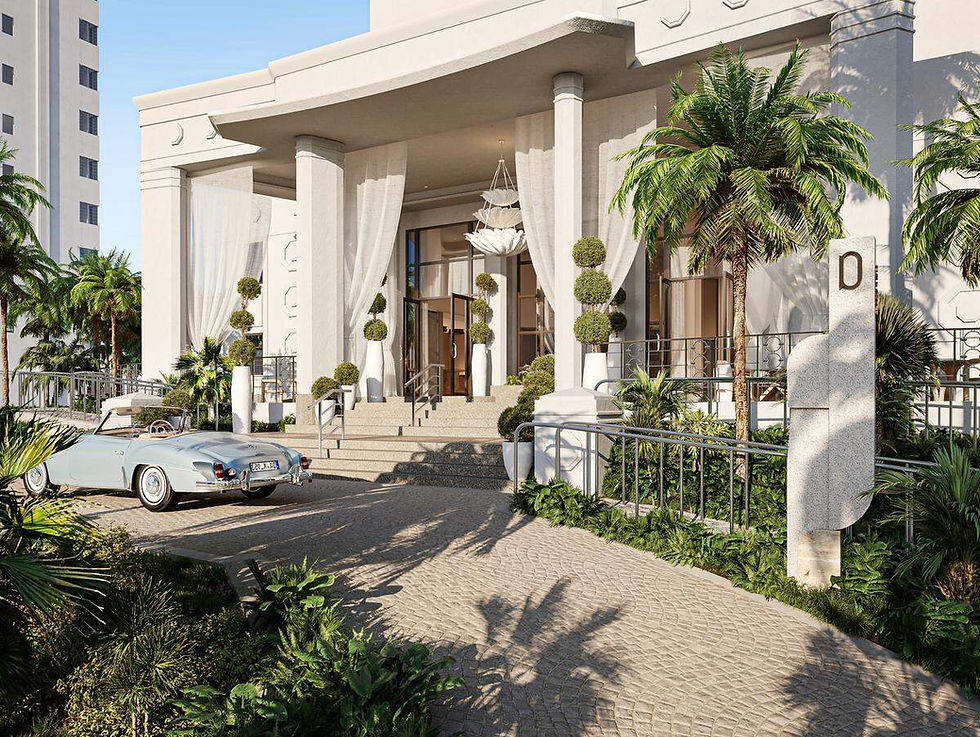
There was a time when nearly every meaningful evening in Miami Beach seemed to pass through the Delano.
Fashion editors lingered beneath towering white curtains after midnight. Models drifted through the lobby barefoot from the pool. Art Basel dinners stretched into sunrise conversations. The air smelled faintly of gardenias, saltwater, and expensive sunscreen.
Even those who never stayed at the hotel understood its gravity. The Delano was not simply a place to sleep—it was where Miami performed its most cinematic version of itself.
Now, after six years behind closed doors and an extensive restoration, the legendary hotel has reopened on Collins Avenue, reintroducing one of South Beach’s defining properties to a city that has evolved dramatically since its departure.
And somehow, it still feels unmistakably like the Delano.
Originally opened in 1947, the property entered cultural mythology in the mid-1990s when hotelier Ian Schrager and designer Philippe Starck transformed it into one of the most influential boutique hotels in the world. At the time, hospitality was still largely formal, predictable, and transactional. The Delano changed that. It blurred the lines between hotel, nightlife destination, fashion set, and social theater.
Its design became instantly recognizable: impossibly sheer white drapery moving through cavernous spaces, surreal furniture placed like art installations, oversized columns, dim amber lighting, and a pool scene that felt suspended somewhere between a Slim Aarons photograph and a dream sequence.
The Delano did not just help define South Beach. In many ways, it defined the modern boutique hotel era itself.
That legacy is precisely what made its closure in 2020 feel so significant. Miami continued moving forward—faster, wealthier, more globally influential—but the absence of the Delano left a noticeable gap within the city’s cultural landscape. South Beach never stopped evolving, though many longtime travelers quietly wondered whether the original spirit of Miami glamour had disappeared with it.
The reopening suggests otherwise.
Now operated by Ennismore in partnership with Cain International, the restored Delano Miami Beach feels less interested in nostalgia and more focused on refinement. The new vision preserves the property’s unmistakable identity while allowing it to mature alongside the city around it.
Many of the hotel’s most iconic elements remain untouched. The dramatic white façade still rises above Collins Avenue with quiet confidence. The soaring curtains still catch the ocean breeze. Terrazzo floors reflect the late afternoon light spilling through the lobby.
Outside, the famous pool remains one of the most visually recognizable in Miami Beach—still framed by towering palms and the kind of understated glamour newer properties often struggle to manufacture.
Yet the atmosphere has changed.
Where the Delano of the early 2000s often revolved around spectacle and nightlife excess, the new iteration feels calmer, more restrained, and considerably more private. The energy is no longer built around being seen by everyone in the room. Instead, it leans into the kind of discretion increasingly valued by modern luxury travelers.
The redesigned guest rooms and suites reflect that shift. Warm woods, soft neutral palettes, sculptural lighting, textured stone, and layered fabrics replace the stark minimalism that once defined the property. The result feels residential in the best possible sense—elegant without appearing overly designed.
There is a noticeable softness now.
Morning light filters differently through the suites. The lobby feels quieter in the early hours. Conversations unfold more slowly over espresso near the pool deck. Even the pace of the property seems intentionally recalibrated.
And perhaps that evolution mirrors Miami itself.
Over the last several years, the city has transformed from a seasonal destination into a global center of culture, finance, hospitality, fashion, and technology. International investors have arrived alongside art collectors, founders, athletes, and a new generation of affluent travelers seeking experiences that feel more curated than performative.
The modern luxury traveler no longer wants constant visibility. They want access, privacy, design, and atmosphere. They want hotels that understand emotional experience as much as visual aesthetics.
The Delano appears acutely aware of that shift.
Part of the property now includes a members’ club and an elevated private pool deck, signaling a broader move toward exclusivity and community-driven hospitality. Across Miami and beyond, members-only concepts have become increasingly central to luxury travel, particularly among travelers seeking environments that feel socially curated rather than publicly crowded.
At the Delano, however, the approach feels less corporate than cultural.
That distinction matters.
The property’s culinary direction reinforces this next chapter. Among the hotel’s most anticipated additions is Mimi Kakushi, the acclaimed Japanese concept known for its moody interiors, cinematic presentation, and highly stylized cocktail program. Gigi Rigolatto, the Italian dining concept from Paris Society, also makes its American debut inside the property, further positioning the hotel as a destination for both travelers and locals.
Still, for many returning guests, the emotional centerpiece of the reopening may be the Rose Bar.
For years, it served as the unofficial living room of Miami Beach—a place where artists, designers, celebrities, and travelers disappeared into velvet seating beneath low amber light. The restored version retains much of that seductive atmosphere. Deep red marble, soft shadows, intimate corners, and the familiar sense that something interesting might happen at any moment.
Few hotels understand atmosphere the way the Delano always has.
That may ultimately explain why its return feels so significant.
Luxury hospitality today often leans heavily on scale: larger suites, larger yachts, larger price tags, larger social visibility. Yet the hotels people remember most are rarely the loudest. They are the ones that create a feeling difficult to replicate elsewhere.
The Delano has always excelled at that kind of emotional architecture.
It understands that memory is built through texture, lighting, music, pacing, and the quiet psychology of arrival. The walk through the curtains. The first glimpse of the pool. The sound of conversation echoing through the lobby after midnight. The way the property manages to feel both grand and strangely intimate at the same time.
Those details cannot be manufactured overnight.
They are inherited.
And perhaps that is why the Delano still matters.
Not simply because it reopened, but because Miami remains a city deeply connected to reinvention. The Delano’s return arrives during a moment when legacy properties across South Beach are being thoughtfully restored rather than replaced entirely—a reminder that history, when handled carefully, can still feel modern.
The new Delano does not attempt to recreate the Miami Beach of twenty years ago. That version of the city no longer exists.
Instead, it offers something more compelling: a hotel that remembers what made Miami magical in the first place while understanding exactly what the modern traveler now craves.
And on certain evenings, just after sunset, the Delano once again looks exactly as it should—white curtains moving softly behind glowing windows while the energy of Miami Beach gathers around it once more.


Comments